Hikari in Kenya: 100% blood-sugar claims, 90% remission and no study link
Hikari’s Kenya sales page claims 100% normal blood sugar and 90% diabetes remission, but links no trial report. We examine the 6,480 KES course offer, label and evidence.
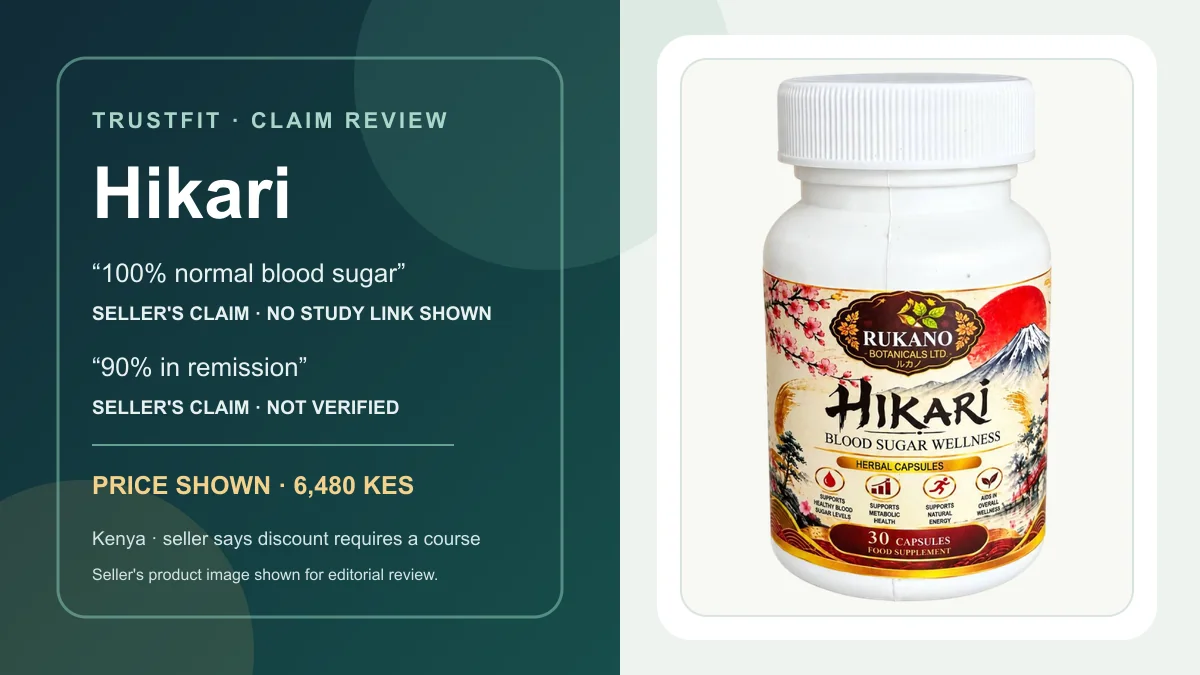
Hikari’s Kenya sales page does not just promise “wellness.” It says the product can return people to life “without diabetes,” calls it effective for diabetes prevention and management, and claims long-term remission. The page also says a 2022 trial of 2,649 people produced 100% normal blood sugar, 96% restored pancreatic function and 90% remission for more than six months. Those are the seller’s claims. The page links no trial report that lets a reader check them.
A headline trial with no paper, registry or protocol
The page names an “Endocrinology Research Institute” but gives no study title, authors, location, journal, trial registration number, protocol, comparison group or link to results. It does not explain how diabetes was diagnosed, what “restored pancreatic function” means, which blood-sugar test was used, or how the 90% remission figure was defined. Without those details, the impressive percentages are not independently checkable evidence.
“Remission” has a clinical definition; a sales page cannot establish it
An international consensus report published in Diabetes Care defines remission of type 2 diabetes using a measured HbA1c below 6.5% that persists for at least three months without glucose-lowering medication. It also says remission is not the same as a cure and requires ongoing monitoring because high blood sugar can return. Hikari’s page gives no participant-level measurements, medication history or follow-up data to show that its “90%” figure meets that standard.
The bottle image and the seller page name different companies
The product image on the sales page shows a 30-capsule “Hikari Blood Sugar Wellness” bottle labelled “Rukano Botanicals Ltd.” The footer separately identifies Galaxy Trade LTD, gives a London address and a Gmail contact. The page does not explain the relationship between the label and the seller, name a Kenyan responsible business, or show a Kenyan product registration number. That gap does not prove the product is counterfeit; it does mean buyers should ask who makes it, who sells it locally and which exact product registration covers the bottle.
An ingredient list is not proof that this formula treats diabetes
The page lists glucomannan, shiitake beta-glucans, green-tea extract, chromium, B vitamins, zinc, barberry and cinnamon. It does not show the amount of each ingredient per capsule or a full label that can be matched to the trial it claims. The U.S. National Center for Complementary and Integrative Health says evidence for supplements such as chromium and cinnamon is limited or conflicting, and there is no reliable evidence that herbal supplements control diabetes. Evidence about an isolated ingredient also cannot establish that this branded combination works.
Check the product with Kenya’s Pharmacy and Poisons Board
Kenya’s Pharmacy and Poisons Board oversees marketing authorisation for health supplements and publishes registration guidance and product registers. The Hikari sales page shows no Kenyan registration identifier that a buyer can match to this bottle. Ask the seller for the exact PPB registration number and the Kenyan company responsible for the sale, then confirm the details with the Board. A product listing or registration is a regulatory check; it is not proof that the seller’s diabetes-treatment claims are clinically true.
The 6,480 KES price comes with a course condition
The page shows 12,960 KES crossed out and 6,480 KES as the offer price, then adds: “This one-pack discount is only valid when ordering a course.” It does not make the minimum course quantity or final course total clear next to the price. The form asks for a name and phone number; a countdown and a “41 units left” notice push the visitor to act quickly. Before giving consent on a callback, get the number of packs, full total including delivery, seller’s legal name, cancellation and return terms in writing.
Do not replace diabetes care with a phone-order supplement
The World Health Organization describes diabetes as a condition requiring long-term care. Management can include healthy eating, activity, glucose monitoring, medicines and regular follow-up; the right plan depends on the person. NCCIH warns people not to replace effective diabetes treatment with an unproven product. Do not stop or change prescribed medicine because of this advertisement; discuss supplements with a clinician or pharmacist, especially if you take diabetes medication.
Where to check or report a problem in Kenya
Keep screenshots of the offer, the price shown, messages, call details, order confirmation and receipt. The Pharmacy and Poisons Board provides product registers and enquiry channels for health-product questions. For a misleading price or sales representation, the Competition Authority of Kenya accepts consumer complaints and can refer issues outside its jurisdiction to the relevant agency.
Our conclusion
We do not recommend buying Hikari as a treatment for diabetes. The seller makes sweeping claims about normal blood sugar, pancreatic recovery and remission, but its page supplies no study report or data to verify those numbers. It also leaves the course price and the relationship between the bottle label and the seller unclear. We have not bought or laboratory-tested Hikari, and this review does not establish fraud or the contents of any delivered pack. The burden is on the seller to provide verifiable evidence and clear Kenyan sale terms before asking people to trust a diabetes-treatment promise.
We reviewed the Hikari sales page, the cited product image and the listed checkout terms, then compared the claims with WHO guidance, the international remission consensus report, NCCIH evidence summaries and Kenya PPB information available on 26 October 2026.
Sources
- Hikari Kenya sales page — seller claims, 2022 study figures, bottle image and 6,480 KES offer ↗ Link checked: 2026-10-26
- World Health Organization — Diabetes: diagnosis, management and long-term care ↗ Link checked: 2026-10-26
- Diabetes Care — international consensus definition and interpretation of type 2 diabetes remission ↗ Link checked: 2026-10-26
- NCCIH — Diabetes and Dietary Supplements: What You Need To Know ↗ Link checked: 2026-10-26
- Kenya Pharmacy and Poisons Board — Registration guideline for health supplements ↗ Link checked: 2026-10-26
- Kenya Pharmacy and Poisons Board — marketing authorisation, registered product lists and contacts ↗ Link checked: 2026-10-26
- Competition Authority of Kenya — file a consumer complaint ↗ Link checked: 2026-10-26